More from Sally Nex’s talk to the Stonehouse Gardening Club on how to grow fruit trees in small gardens – and even pots! This blog post outlines what gardeners should do to grow fruit trees from apple and yuzu trees to kiwi vines.
Apples and pears
You can grow apple and pear trees in a small garden if there are walls and fences. By selective pruning, walls and fences can be utilised to support smaller fruit trees as fan trained, espaliers, cordons and columns. Free standing supports of posts with wires are also useful. Low boundaries can be created with “step-over” trained trees, a useful technique to divide the garden.)
Choice of the rootstock is critical, with semi-dwarf the most manageable for training, M9 or M26. For training plum or gages and damson trees try Pixy. (St Julian A produces a more vigorous and larger tree.)
The easiest to do is the cordon, which is also very productive. Plant the maidens 2 feet apart at a 45 degree angle. You can mix the varieties and even species. Keep the side shoots pruned back to just two buds and remove any shoots that grow into the wall or fence or outwards.
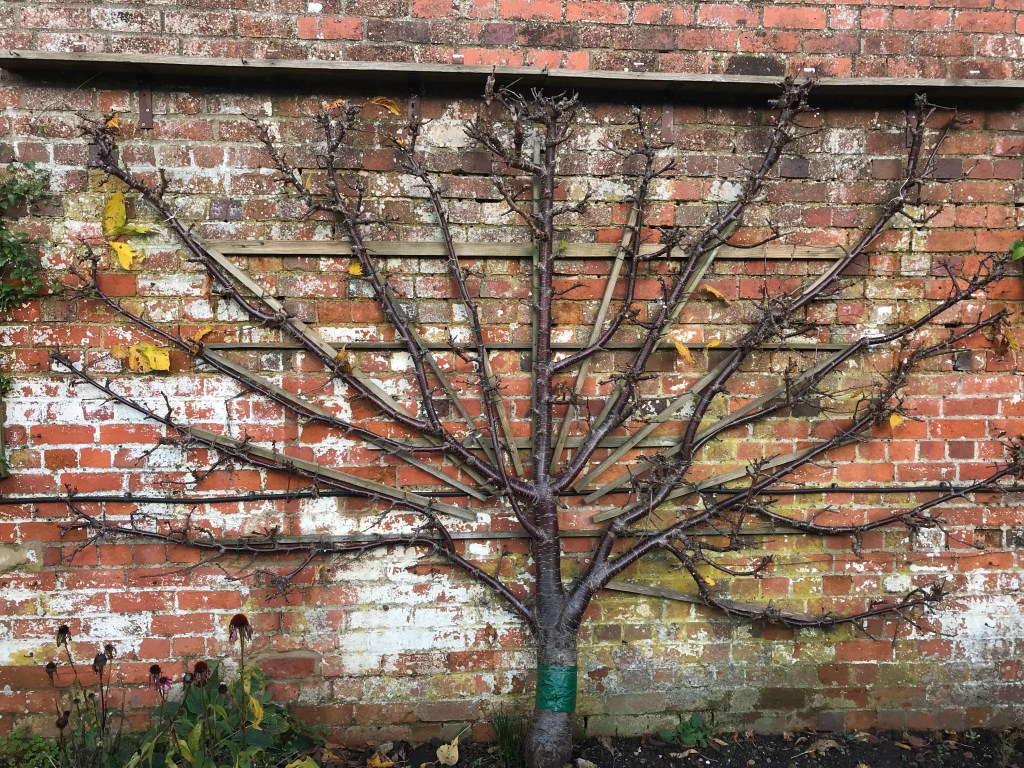
For traditional espaliers, growth is kept horizontal, off the main stem and trained along wires. However, a lovely diamond pattern or Belgian Fence can be made by planting several maidens 2 feet apart, cutting off the leader above two shoots, and training those into a 45 degree V each side of the main stem. Choose shoots about 18 inches apart on each of the new leaders to grow perpendicular to them. These can be trained to make diamond boxes against the wall or fence.
The detail for how to prune fruit trees into these 2D shapes can be found in many excellent books and is easy enough to learn. Prune the trees in winter for pip fruits (apples, pears, etc.), but in the summer for stone fruit such as cherries, plums, apricots etc.
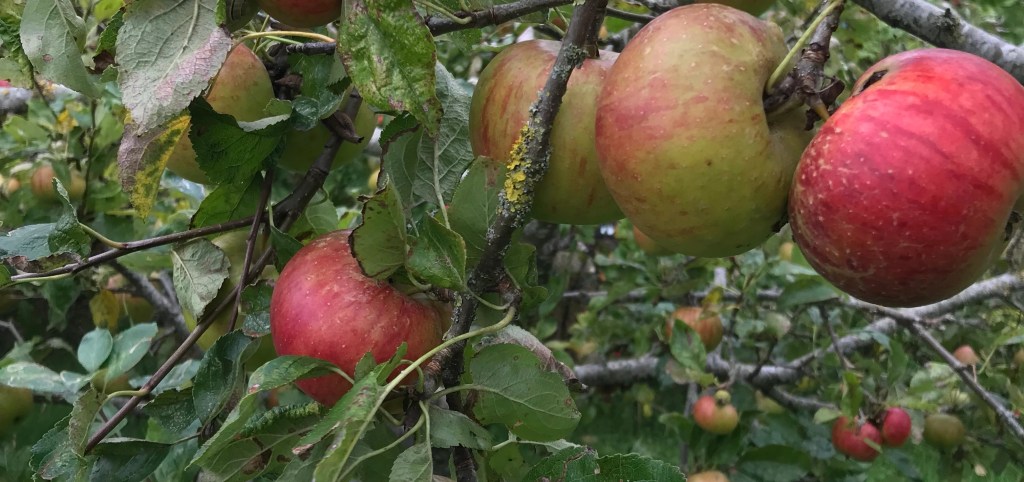
Note: If your apple tree is not doing the June drop and producing too many small fruits, reduce the fruiting spurs to one every 10 cm or every other one when pruning.
Berries
Berry fruit, apart from currant bushes, can also be trained as cordons or espaliers. This is advantageous for gooseberries especially, as the effect of removing inward or outward growth, deters the sawfly. These pests like to lay eggs inside the prickly bush, where they are safer from hungry birds. Berries grown against a wall or as cordons are easier to pick and ripen well against a warm wall.
Medlar
These trees have a mass of large white blossom and are quite well behaved as well as self-fertile. Picked when nearly mature and ripened indoors for a fortnight, this fruit can be eaten with a teaspoon, avoiding the pips.
Quince
This highly scented large fruit also has showy blossoms. It can be susceptible to blight; Serbian Gold variety is resistant to this, and is quite compact.
Yuzu
This citrus fruit is hardy to minus 8 degrees in a sheltered position, and has an intense lemon flavour in zest and juice. Give it a sunny spot and free draining acid soil; prune it in midsummer and enjoy the flowers in winter.
Japanese pears
These pears are well worth growing for flavour and are very hardy. The lovely looking fruit are crisp and juicy, and without any pest issues.
Japanese Wineberry
Japanese wineberry canes are like bristly raspberries, which deters birds. Remove fruiting canes after fruiting.
Kiwi
This fruit grows on big vines, but kiwi Issai is more compact and self -fertile. The shiny fruits are a little smaller than shop ones, but are prolific and can be trained over a fence.
Fruit in pots
Growing fruit in pots is very successful on a sunny patio or balcony. The trick with pots is regular weekly watering and feeding from March to October, especially the former in heatwaves. Liquid seaweed is a good food. When flowering, switch to liquid comfrey for potassium.
Strawberries
These small berries make excellent pot plants. They stay clean and are out of the way of slugs. Use loam based soil and they will last several years.
Blueberries
They like acid soil and moisture, so use peat free ericaceous soil and line any terracotta pots with a sparsely perforated old compost bag, and place a saucer under the pot. With blueberries, try having two varieties near each other for better results.
Lemons
Lemons cannot be grown outside. They can, however, be grown indoors in pots, and overwintered in a cold greenhouse, but keep them nearly dry. Do not be tempted to leave them in the greenhouse in summertime. They do not appreciate humidity. Keep in a sunny spot.
Ballerina apples
Grow these apples as columns or minarets are suitable for pots as they are on fully dwarf rootstocks. They need large pots and permanent staking.
Will Sibley’s Lescovec quince is good on a patio, and you can also find apricots and peaches for potting. Figs are rampant growers, so they are usually better with their roots restricted in a 60-65 cm container. They are also good grown fan trained.
For more information, read this RHS article on growing fruit in containers.
Note: If you are moving house and have fruit bushes, dig them up as close to removal time as possible and replant quickly. Cut the plant right back. As an insurance, take hard cuttings in the autumn.
This is the second article based on Sally Nex’s talk to the Stonehouse Gardening Club in November, 2023. Read the first article here: Small gardens: Grow tree and berry fruit
 Stonehouse Gardening Club